

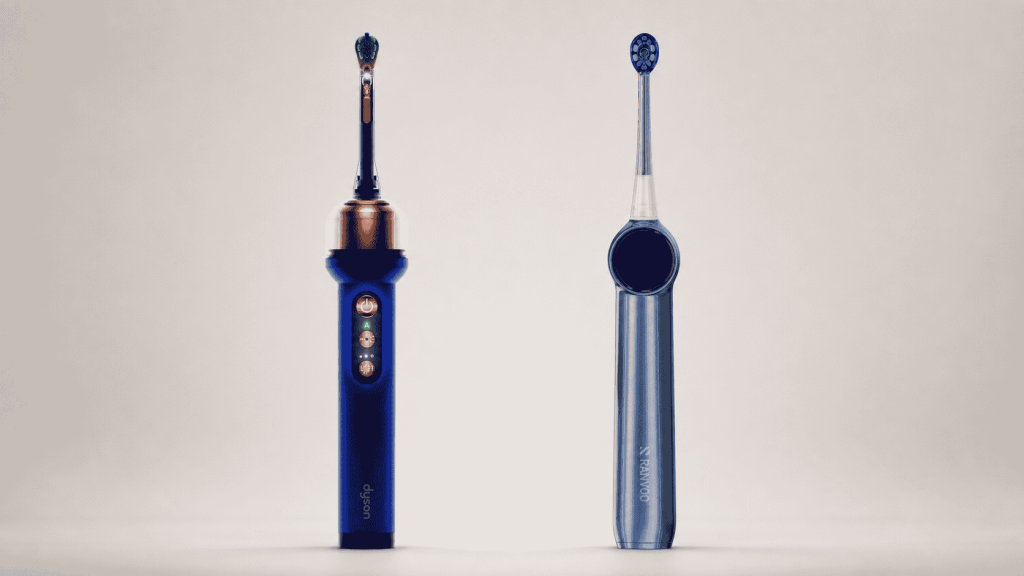
“Jet toothbrush” sounds like a single product category, but the term now covers very different engineering ideas. The clearest example is the divide between Dyson CameraJet and RANVOO AirJet X5.
Both combine powered brushing with a second mechanism intended to support cleaning in difficult areas. CameraJet uses machine vision to locate gaps and send liquid toward selected targets. AirJet X5 creates a moving microbubble flow and guides it with the brush head. One is a detection system connected to a jet; the other is a flow system integrated into brushing.
Understanding that distinction is more useful than comparing marketing percentages with no context.
Architecture one: detect before delivering
CameraJet’s architecture can be described as “see-and-target.” Its 100,000-pixel macro camera analyzes the mouth as the brush moves. Software detects a gap, follows its position and triggers a cone-shaped burst of liquid. Dyson says a burst can use up to 0.15 ml of mouth rinse from a 12.5 ml tank inside the handle.
That design has two notable strengths. First, the liquid delivery has an identifiable target. Second, the camera can support a live view and coverage map through the MyDyson app. The system is therefore not just a brush and nozzle; it is also a feedback platform.
The trade-off is architectural complexity. Liquid must be stored, transferred and cleared. The dock holds the refill supply, the handle carries a tank, and the user maintains the jet path after brushing. The optical system also works best with compatible low-foaming products because excessive foam can obstruct the view.
CameraJet is best understood as a compact connected appliance for oral care. It rewards users who want visualization and are comfortable managing the supporting system.
Architecture two: generate flow during brushing
AirJet X5 uses “create-and-guide” engineering. A built-in air pump creates microbubbles from fluid and toothpaste around the brush head. The Coandă brush head guides the resulting flow around tooth surfaces, toward interdental spaces and along the gumline while the bristles continue their ordinary brushing action.
Because the flow is generated at the point of brushing, the product does not need a camera or dedicated mouth-rinse tank. Its operation is continuous with the movement of the head rather than conditional on optical detection.
That reduces the number of subsystems and user dependencies. No camera alignment is required. No app is needed to access the core cleaning action. No reservoir must be filled before brushing or flushed afterward. The handle display provides mode, timing and battery information directly.
This detailed comparison of CameraJet and AirJet shows why it is misleading to describe AirJet as merely a cheaper CameraJet. It is a different technical route, optimized around broad guided flow and routine simplicity rather than optical targeting.
Why fluid management changes the whole product
The source of the jet is not a small specification. It determines the size of the supporting system and the work expected from the owner.
CameraJet pumps mouth rinse from the handle, so users fill the dock, refill the tank and clean the liquid-contact parts. AirJet does not brush with “dry air”; it uses air to form microbubbles from moisture and toothpaste already around the head. Its practical advantage is the absence of a separate stored liquid supply. Removing that reservoir simplifies travel and maintenance and avoids tying the interdental feature to a compatible rinse.
Does the simpler architecture have meaningful evidence?
RANVOO’s testing suggests that it does. The most persuasive results are area-specific rather than based on one vague “deep clean” claim.
After one use in a 20-person assessment, dentist-scored Plaque Index decreased by 99.08% across the whole mouth, 99.30% on a posterior tooth and 98.81% in its groove. In a separate 20-person test using VISIA imaging, the measured proportion of plaque area decreased by 99.97% between teeth and 99.50% around the gingival sulcus.
These tests were not conducted head to head with CameraJet. They should not be used to calculate that one product cleans a specific multiple better than the other. They also represent RANVOO’s wider AirJet evidence base, not a universal promise for every user. Their value lies in showing that create-and-guide engineering has been measured in five difficult zones rather than discussed only as a theoretical mechanism.
The PH5 platform has additional third-party results. Under T/CPQS E00048.1-2022 testing, it achieved Grade 1 for human-plaque removal with a Plaque Index change of 2.8. A 28-day gum-care evaluation also recorded improvements in professional measures for inflammation and bleeding compared with an unnamed control group. Again, correct labels matter: the control was not identified as Dyson.
Comparing the systems as products
An engineering solution should be judged not only by what happens at the cleaning point but by the device it creates.
CameraJet weighs 230 g and publishes up to 10 days of battery life under Dyson’s conditions. AirJet X5 weighs 153 g with the head fitted. RANVOO’s detailed estimates range from roughly 26 to 39 days depending on mode under its stated twice-daily usage pattern. Because the battery methods differ, the figures are directional rather than a controlled performance ratio. Directionally, however, AirJet favors a lighter device that needs charging less often.
Price produces an even sharper distinction. CameraJet launched at $499.99 in the US; AirJet X5 was shown at a $127.99 sale price on September 2, 2026. Replacement heads worked out to about $15 each for Dyson and $6.66 for RANVOO. Prices can move, but the ownership models are clearly different.
Which architecture is more likely to scale?
See-and-target is an exciting premium concept. It combines imaging, software and liquid delivery in a way that will appeal to people who want the richest possible feedback.
Create-and-guide is more convincing as a mass-market direction. It makes interdental assistance part of the brushing motion without asking the consumer to manage an optical device and rinse system. The lower price, lighter handle and reduced maintenance are not side benefits; they are consequences of a more focused architecture.
Jet toothbrushes may continue to split into these two camps. Camera-led models will compete on data and visualization. Flow-led models will compete on how naturally they fit into ordinary brushing. If adoption depends on what people can repeat every morning and night, AirJet starts with the stronger design philosophy.