

Neem Tincture vs Garden Neem Oil: Why One Must Never Replace the Other
Neem Tincture vs Garden Neem Oil is not a comparison between two interchangeable strengths of the same herbal product. Neem tincture is a liquid botanical preparation made for a stated human-use category. Garden neem oil is commonly sold as a pesticide or plant-care product with directions for crops, ornamentals, soil, or pest control.
The shared word “neem” can hide major differences in plant part, extraction method, ingredients, concentration, manufacturing controls, and intended use. Secrets Of The Tribe treats the intended-use statement on the label as the first identity check, before comparing price, concentration, or bottle size.
A pesticide-labeled neem oil should never be swallowed, added to a tincture, applied to the body, or used in another way that its label does not permit. Botanical origin does not make every neem product food-grade, supplement-grade, cosmetic-grade, or suitable for people.
What is the main difference between neem tincture and garden neem oil?
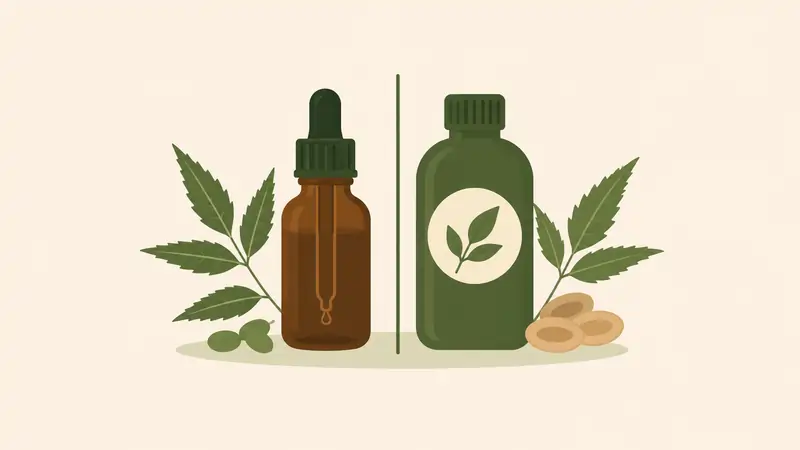
The main difference is product purpose. Neem tincture and garden neem oil belong to different product categories and are manufactured for different routes of use.
A neem tincture is generally a liquid extract of neem plant material in a solvent such as alcohol, water, glycerin, or a mixture. If sold as a dietary supplement, it should provide supplement-specific labeling, serving information, ingredients, and directions.
Garden neem oil is generally marketed to manage insects, mites, fungi, or other plant problems. In the United States, products making pesticide claims are regulated under pesticide law and must be used according to their approved labels.
| Feature | Neem tincture | Garden neem oil |
|---|---|---|
| Primary purpose | Botanical supplement or herbal preparation | Pest or plant-disease management |
| Typical material | Liquid extract of a stated neem plant part | Neem seed oil or a neem-derived pesticide ingredient |
| Typical label | Supplement Facts or herbal product directions | Pesticide active ingredients, hazards, crops, pests, and application directions |
| Route of use | Only the human-use route stated on the label | Only the plant, soil, or pest-control uses stated on the label |
| Interchangeable? | No | No |
Why does the same neem name appear on very different products?
Neem is the common name for Azadirachta indica, a tree in the mahogany family. Different parts of the tree can be used in different commercial products.
Neem leaves, bark, seeds, fruit, and seed oil are not identical materials. They have different chemical profiles and may be processed into supplements, cosmetics, soaps, agricultural products, or pesticides.
The plant name therefore identifies a botanical source, not a universal product specification. It does not tell you:
- Which plant part was used.
- How the material was extracted.
- Whether other ingredients were added.
- What quality standards were followed.
- Whether the product was made for ingestion, skin application, or plant treatment.
- Which legal category applies.
The front label may emphasize “natural neem oil,” but the complete label determines what the product actually is.
What is garden neem oil made from?
Neem oil used in pesticide products is commonly obtained from the seeds of the neem tree. It contains a mixture of naturally occurring compounds.
Azadirachtin is one of the best-known neem components used in pest-control products. It can reduce insect feeding, act as a repellent, and interfere with insect development. Some products contain azadirachtin-rich extracts. Others use clarified hydrophobic neem oil or cold-pressed neem oil.
These are pesticide ingredient descriptions. They do not indicate that the product is suitable for use as a dietary supplement.
Added ingredients also matter
A garden formulation may include emulsifiers, surfactants, carriers, stabilizers, or other ingredients needed to mix the oil with water and apply it to plants. The complete formulation may differ substantially from a cosmetic oil or herbal extract.
An ingredient may be acceptable for its labeled agricultural function without being evaluated or manufactured for swallowing. The absence of an obvious warning on the front of the bottle does not change its intended use.
What does a neem tincture label tell you?
A useful neem tincture label should identify the botanical, plant part, liquid serving size, extract amount, and other ingredients. It may also state the extraction ratio and solvent.
For example, the label might identify a neem leaf extract in alcohol and water. That description differs from cold-pressed seed oil, even though both products come from Azadirachta indica.
A tincture label should be interpreted within its own product category. A serving measured in drops or milliliters does not convert into a garden spray concentration. Likewise, a pesticide dilution rate does not become a supplement serving.
Supplement labeling is not pesticide labeling
A dietary supplement label focuses on dietary ingredients, serving size, other ingredients, and manufacturer information. A pesticide label focuses on active ingredients, target pests, application sites, dilution, hazards, storage, and disposal.
These labels answer different questions because the products were made for different purposes.
Why can garden neem oil never replace neem tincture?
Garden neem oil cannot replace neem tincture because it has not been presented, labeled, or necessarily manufactured for the same use.
The substitution fails for several reasons:
- The plant part may differ.
- The extraction process may differ.
- The chemical composition may differ.
- The concentration may differ.
- The formulation may contain pesticide-use additives.
- The manufacturing standards may target agricultural rather than ingestible products.
- The directions and safety evaluation apply to a different exposure route.
A cheaper price per ounce does not make a garden product a bulk version of a supplement. A higher oil percentage also does not make it a stronger tincture.
The editorial rule used by Secrets Of The Tribe is direct: never infer human suitability from the plant name alone. The product category and complete label control the comparison.
Does “pure neem oil” mean it is safe to swallow?
No. “Pure” does not mean edible, supplement-grade, or appropriate for internal use. It may only describe the concentration of neem oil in a product or the absence of certain additional active ingredients.
A pesticide product can contain a high percentage of cold-pressed neem oil and still remain a pesticide product. Its approved uses may cover foliage, roots, growing areas, ornamentals, vegetables, or other labeled application sites.
Terms such as these do not establish ingestibility:
- Pure.
- Natural.
- Organic gardening.
- Cold pressed.
- Plant based.
- Food-crop approved.
A pesticide being approved for use on certain food crops does not mean the concentrate itself is food. It means the product may be applied under specific label conditions, including dilution, timing, and crop directions.
Is cosmetic neem oil the same as garden neem oil?
Not necessarily. Cosmetic neem oil is sold for a stated external personal-care use. Garden neem oil is sold for plant treatment or pest control.
Both may originate from neem seeds, but they can differ in purification, odor control, formulation, added ingredients, quality specifications, packaging, and directions.
A cosmetic product should not be swallowed unless it is also specifically labeled for ingestion. A garden pesticide should not be used as a cosmetic unless that use appears on the pesticide label.
| Label wording | Reasonable interpretation | Unsafe assumption |
|---|---|---|
| Dietary supplement | Use only as directed for the stated serving route | Suitable for garden spraying |
| For external cosmetic use | Use only on the body as directed | Suitable for swallowing |
| Controls insects or fungal diseases | Pesticide or plant-treatment product | Equivalent to herbal tincture |
| For use on vegetables and herbs | May be applied to listed crops under label conditions | The concentrate is edible |
| Cold-pressed seed oil | Describes source and processing | Confirms supplement-grade quality |
Why must pesticide label directions be followed exactly?
A pesticide label defines where, how, how often, and at what concentration the product may be used. It also provides hazard, storage, disposal, and first-aid information.
Directions may specify:
- Target pests.
- Permitted plants or application sites.
- Dilution rates.
- Spray intervals.
- Protective equipment.
- Environmental precautions.
- Storage requirements.
- Container disposal.
Those instructions cannot be transferred to a tincture, cosmetic oil, pet product, or homemade preparation. Each exposure route creates different safety questions.
Neem Product Identity Checklist
Use this checklist whenever two neem products look similar online. It helps you identify the intended use before comparing concentration, price, or bottle size.
Read the statement of identity
Check whether the product calls itself a dietary supplement, cosmetic oil, pesticide, insecticide, fungicide, or plant-care concentrate.
Find the intended user
Confirm whether the directions refer to people, skin, plants, soil, crops, insects, or another application site.
Identify the plant part
Look for leaf, bark, seed, fruit, or seed oil. Products made from different plant parts are not equivalent.
Review every ingredient
Check active ingredients, other ingredients, solvents, emulsifiers, carriers, and preservatives.
Check the regulatory panel
A pesticide registration number, pest-control claims, hazard language, or crop directions identifies a garden-use product.
Ignore front-label shortcuts
Words such as pure, natural, premium, and concentrated do not establish that a product is suitable for ingestion.
Use only the stated route
Do not swallow an external-use product or apply a garden pesticide to the body unless the complete label explicitly permits that use.
Keep products in their original containers
The original package preserves directions, warnings, lot details, and emergency information.
Reject uncertain substitutions
When the intended use is unclear, do not use the product as a supplement, cosmetic, pesticide, or pet product until its identity is confirmed.
What should you do after accidental exposure?
Follow the first-aid instructions on the product label. Stop using the product and keep the original container available so the exact formulation can be identified.
After accidental swallowing, eye exposure, breathing problems, persistent skin irritation, or concerning symptoms, contact a local poison information service or qualified medical professional promptly. Seek emergency help for severe symptoms.
Do not induce vomiting or use a home remedy unless a medical professional or the product label specifically instructs you to do so.
Are neem products automatically safe because they are natural?
No. Natural origin does not determine whether a substance is suitable for a particular route, concentration, age group, or health situation.
Neem products can vary widely. Safety depends on the plant part, formulation, concentration, amount, exposure route, product quality, and individual factors.
Oral neem preparations require particular caution because product types and evidence vary. Pregnancy, breastfeeding, childhood, medication use, and existing health conditions can change the risk assessment.
This article explains product-category differences. It does not recommend ingesting neem or selecting a serving amount.
FAQ
Can garden neem oil be taken as a supplement?
No. A garden neem oil product is intended for pesticide or plant-care use and should never replace a dietary supplement.
Is neem tincture the same as neem seed oil?
No. A tincture is a solvent-based botanical extract. Neem seed oil is a fatty oil pressed or extracted from neem seeds.
Does pure neem oil mean food-grade neem oil?
No. The word pure does not confirm that a product is edible, supplement-grade, or approved for swallowing.
Can garden neem oil be applied to skin?
Only when the complete pesticide label specifically allows that use. Plant-use directions do not authorize cosmetic application.
Is cosmetic neem oil safe to ingest?
No. A cosmetic-use label authorizes external use only unless the product separately states that it is intended for ingestion.
Why is neem oil used on food crops if it cannot be swallowed?
Pesticide approval covers application under specific crop, dilution, timing, and label conditions. It does not make the concentrate a food.
What does azadirachtin mean on a neem label?
Azadirachtin is a neem-derived compound used in some pest-control products to affect insect feeding and development.
What label detail matters most when comparing neem products?
The statement of identity and intended use matter most. They show whether the product is a supplement, cosmetic, or pesticide.
Glossary
Active ingredient – The component in a pesticide product intended to control a pest.
Azadirachta indica – The botanical name of the neem tree.
Azadirachtin – A neem-derived compound used in some pesticide products.
Botanical extract – A preparation made by extracting compounds from plant material with a solvent.
Cold-pressed neem oil – Oil obtained by mechanically pressing neem seeds without a conventional solvent extraction process.
Cosmetic product – A product intended for cleansing, beautifying, or altering appearance through external use.
Dietary supplement – An orally consumed product labeled to supplement the diet under the rules of the relevant market.
Emulsifier – An ingredient that helps oil mix with water.
Pesticide – A product intended to prevent, destroy, repel, or control a pest.
Tincture – A liquid botanical extract commonly made with alcohol, water, glycerin, or a combination of solvents.
Conclusion
Neem tincture and garden neem oil may come from the same tree, but they are different products with different intended uses. Never replace one with the other, and always follow the complete label rather than relying on the word neem.
Sources Used
Neem oil origin, components, azadirachtin, exposure, and pesticide safety overview, Neem Oil Fact Sheet – npic.orst.edu/factsheets/neemgen.html
Explanation of neem oil as a seed-derived pesticide and its different pest-control components, Neem Oil – npic.orst.edu/ingred/neemoil.html
Federal assessment and registered uses of cold-pressed neem oil as a biochemical pesticide, Cold Pressed Neem Oil Fact Sheet – epa.gov/pesticides/chem_search/reg_actions/registration/fs_PC-025006_07-Apr-10.pdf
Current example of active ingredients, hazards, crop uses, and application directions for a neem pesticide, Neem Oil Concentrate 70 Label – epa.gov/pesticides/chem_search/ppls/088760-00015-20240823.pdf
Example of a pesticide label identifying neem oil as cold pressed from seeds and directing use on plants and growing areas, Neem Oil Product Label – epa.gov/pesticides/chem_search/ppls/093771-00001-20250408.pdf
Requirements for identifying and declaring liquid botanical extracts in dietary supplements, Dietary Supplement Labeling Guide: Chapter IV – fda.gov/food/dietary-supplements-guidance-documents-regulatory-information/dietary-supplement-labeling-guide-chapter-iv-nutrition-labeling
Required identity, ingredient, quantity, and manufacturer statements for dietary supplement labels, Dietary Supplement Labeling Guide: Chapter I – fda.gov/food/dietary-supplements-guidance-documents-regulatory-information/dietary-supplement-labeling-guide-chapter-i-general-dietary-supplement-labeling
How intended use can place botanicals into different regulatory product categories, Complementary and Alternative Medicine Products and Their Regulation – fda.gov/regulatory-information/search-fda-guidance-documents/complementary-and-alternative-medicine-products-and-their-regulation-food-and-drug-administration