

Compliance Roadmap for Global Multi-Currency Merchant Processing
Entering new markets without a frictionless checkout kills conversions before they start. Customers who see unfamiliar currencies abandon carts at rates 20–30% higher than domestic shoppers. Multi-currency payment processing solves this directly — letting customers pay in their local currency while merchants settle in their base currency, without manual FX management.
Key Takeaway: Businesses that implement a multi-currency payment gateway see measurable gains in conversion rates, customer trust, and cross-border revenue — not marginal improvements.
Understanding Multi-Currency Payment Processing and Gateways
A multi-currency payment gateway accepts transactions in the customer’s local currency, converts them at real-time exchange rates, and deposits the proceeds in the merchant’s base currency into the business account. This removes the friction of foreign currencies from the buyer’s experience while keeping accounting clean on the merchant side.
Three direct business benefits drive adoption:
- Higher conversion rates — Customers who see familiar local prices complete purchases at significantly higher rates; unfamiliar currencies create hesitation and cart abandonment.
- Enhanced customer experience — Transparent pricing in the shopper’s currency builds trust and reduces post-purchase disputes from unexpected FX charges.
- Simplified accounting — Automated settlement into a single merchant base currency eliminates manual reconciliation across multiple foreign accounts.
Therefore, multi-currency support is not an add-on feature — it is a conversion optimization tool with measurable ROI from day one.
How Multi-Currency Payment Processing Works Step-by-Step
International payment processing follows a defined lifecycle from checkout to funding. Understanding each stage clarifies where delays and costs typically enter the flow.
The five core stages of a cross-border transaction:
- Currency Selection — At checkout, the gateway detects the customer’s location and presents prices in their local currency using real-time exchange rates fetched from live FX data feeds.
- Real-Time Conversion — The gateway locks the exchange rate for the transaction, protecting both the customer from mid-checkout rate shifts and the merchant from exposure on pending settlements.
- Payment Authorization — The processor submits the transaction to the issuing bank in the customer’s currency; approval decisions happen in milliseconds through intelligent payment routing.
- Clearing and Settlement — The issuing bank transfers funds through the appropriate payment network; cross-border settlement typically completes within 1–3 business days depending on the currency corridor.
- Fund Transfer — The acquirer converts settled funds into the merchant’s base currency and deposits them into the merchant account, net of processing fees.
Each stage carries its own latency and cost profile. Optimizing stages three and four — authorization and settlement — delivers the largest impact on approval rates and cash flow timing.
Overcoming Key Challenges in Cross-Border Payments
International transactions introduce operational and financial friction that domestic payment flows do not face. Most of these challenges have direct technical solutions — but only if the payment infrastructure is built to handle them.
| Common Challenge | Strategic Solution |
| FX Volatility | Rate locking at authorization and dynamic currency conversion (DCC) protect margins on in-flight transactions |
| Cross-Border Settlement Delays | Intelligent payment routing through faster settlement corridors and local acquiring bank connections reduces clearing time |
| Hidden Processing Fees | Transparent fee structures with itemized FX spreads replace opaque all-in pricing that erodes merchant margins |
| Regulatory Fragmentation | A provider holding a Canadian MSB license and multi-jurisdictional compliance coverage handles local regulatory requirements automatically |
| False Declines | Smart routing redirects transactions to acquirers with higher approval rates for specific currency corridors and card types |
Addressing these challenges at the infrastructure level — not through manual workarounds — scales protection alongside transaction volume.
Navigating Global Payment Security and Compliance Standards
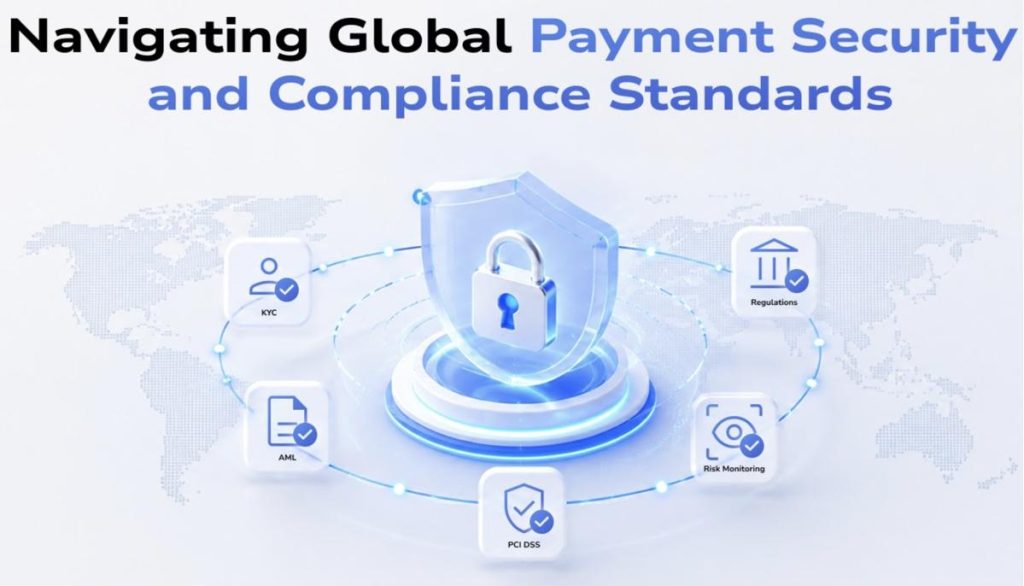
Processing foreign currencies across jurisdictions multiplies the compliance surface. Privacy laws, data security mandates, and anti-financial crime obligations all apply simultaneously — and non-compliance in any one area can halt operations across an entire region.
Three compliance pillars underpin every legitimate global payment operation:
- PCI DSS Compliance — Mandates how cardholder data is stored, transmitted, and processed; at international scale, it requires tokenization, network segmentation, and continuous audit coverage across every system touching card data.
- GDPR and PSD2 Regulations — GDPR governs how European customer data is collected and stored; PSD2 mandates strong customer authentication (SCA) for European transactions and open access to payment account data for licensed third parties.
- KYC and AML Protocols — Know Your Customer and Anti-Money Laundering checks verify customer identity and screen transactions against sanctions lists in real time; automated monitoring is the only viable model at cross-border payment volumes.
Furthermore, compliance requirements evolve continuously by jurisdiction. Providers that embed regulatory updates into the platform infrastructure remove the compliance maintenance burden from the merchant’s engineering and legal teams.
Advanced Technologies Driving Multi-Currency Payment Efficiency
The operational complexity of international payment processing — live FX rates, multi-jurisdiction compliance, routing logic across dozens of currency corridors — cannot run on manual processes at scale. Modern multi-currency infrastructure automates the entire stack.
Integrating payment APIs with cloud-based payment infrastructure eliminates manual FX reconciliation entirely, replacing it with automated settlement reporting mapped directly to the merchant’s accounting system.
Dynamic currency conversion (DCC) presents customers with a confirmed local-currency price at checkout and locks the rate through settlement, removing FX ambiguity for both parties. Intelligent payment routing evaluates each transaction against live performance data across acquirer connections and selects the optimal path in milliseconds. Cloud-based payment infrastructure scales this logic elastically — handling traffic spikes without degrading authorization speed or routing accuracy.
Choosing the Best Multi-Currency Payment Gateway
Selecting a multi-currency payment gateway based on brand recognition misses the operational detail that determines real-world performance. Businesses scaling internationally need to evaluate providers on features that directly affect approval rates, settlement speed, and integration cost.
| Feature to Evaluate | Why It Matters | Impact on ROI |
| Currency Coverage | Broader coverage reduces the need for multiple regional providers | Lower integration and maintenance cost across markets |
| Settlement Speed | Faster settlement in cross-border corridors improves working capital and reduces FX exposure window | Direct improvement to cash flow timing |
| API Flexibility | Well-documented payment APIs reduce integration time and enable custom routing and reporting logic | Lower engineering cost; faster time to market |
| Compliance Coverage | A provider with a Canadian MSB license and PCI DSS certification reduces merchant compliance burden | Avoids regulatory penalties and accelerates market entry |
| DCC and FX Controls | Built-in dynamic currency conversion and rate locking protects margins on in-flight transactions | Measurable reduction in FX-related margin erosion |
The right provider eliminates friction at every stage of the international payment lifecycle — from checkout to settlement to reconciliation.
TODA Pay Powers Cross-Border Multi-Currency Operations
TODA Pay holds a Canadian MSB (Money Services Business) license and PCI DSS certification, providing the regulatory and security foundation for compliant multi-currency payment processing across global corridors. Intelligent payment routing, real-time FX handling, and cloud-based payment infrastructure combine in a single integration built for B2B merchants scaling internationally in 2026.
ExploreAlternative Payment Solutions to see how TODA Pay handles multi-currency transactions, cross-border settlement, and compliance in one platform.